




Energy Analysis
Energy analysis measurements can be made with the following PowerSight meters:
PS2500 Power and Data Logger
PS3500 Energy Analyzer
PS4500 Power Quality Analyzer
PowerSight meters are comprehensive power and energy analyzers. PowerSight analyzers can help you answer all your questions about power consumption, energy use in kWh, peak demand, power factor, reactive power (var) and apparent power (va). They are ideal for energy audits and for verifying the performance of energy savings measures and energy efficiency projects.
Find out the answers and solutions to these applications with a PowerSight:
How much power (watts) am I consuming?
When am I consuming the most or least power?
What is my energy use in kWh that I’m being billed for?
What is the peak demand and when does it occur?
Is my power factor too low and incurring a power factor penalty charge from my utility?
I need to reduce energy use in my operation so I need a tool to perform an energy audit of the entire facility, as well as of individual loads, from large motors to small appliances.
I need to take recorded power data into Excel and perform other calculations.
I need to quickly produce professional-looking reports for my company, my vendors, my customers, my utility company.
I need to verify for budgeting purposes, cost justifications, or energy rebates the performance of an energy savings project.
Measuring Power and Energy Use
With a PowerSight meter you can find out how much power is being consumed by a load, a process, an entire building or facility. You can record and display how it is consumed with respect to time, see activity peaks, and identify at what times of the day power consumption is at a maximum or minimum.
Power measurement is made in watts. It involves connecting a PowerSight analyzer to voltage and current on the circuit of interest. Energy in kWh is also measured and plotted. You can connect directly up to 600V rms. A range of current probes is available to measure currents from 5 amps to 6000 amps. If you wish measure power at switchgear or a sub-station the PowerSight will accept PT and CT ratios and report primary values correctly. (See Current Probes)
PowerSight meters are versatile. You can take measurements as either a "spot check" which is a real-time instantaneous measurement like a multimeter, or you can record all power parameters over time. Typically long-term measurements or studies are made over a business cycle such as 24 hours, a week, or a month etc. Recordings over time are referred to as data logs or data logging. Here is an example of power (Watts) recorded over time by a PowerSight.

Reconciling Energy Billing
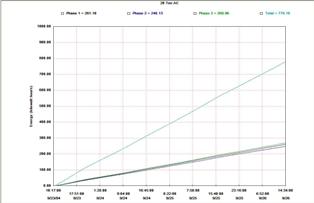
Energy is what consumers of power actually get billed for. It is simply watts x time and is measured in kilowatt hours or kWh. Here is an example of an energy graph showing kWh accumulating over time. The three phase energies are plotted as well as the total for all three phases:
Other billing items may include a peak demand charge in $ per kW or power factor penalty. PowerSight meters Demand power is simply an average of watts over a period of time (i.e. 5 – 30 minutes, typically 15 minutes). The average interval for recording demand can be preprogrammed into a PowerSight meter to match the utility demand interval. Power factor history will also be recorded and the minimum recorded excursion of power factor indicates possible poor (or low) power factor. Costs can be automatically calculated by entering the utility tariff or rate. For calculating costs for more complicated rate structures, such as time-of-use tariffs, the recorded power and energy data can be exported in a single mouse click to Excel
PC Software and Report Generator
All PowerSight meters come with PowerSight Manager (PSM) software for the PC included. PSM allows viewing of graphs, waveforms, phasors, harmonics, and events. Graphs can be zoomed and expanded to see detail, printed, and the data may be exported to Excel.
See a complete report created by the Report Writer here.